
TL;DR
- The best office chair for long hours is the one that adjusts to your body: seat height, seat depth, lower-back support and arm height. Fit matters more than brand or looks.
- Sitting for long, unbroken stretches? Buy a fully adjustable task chair. Eames-style office chairs are design chairs, not task chairs, and we say that as people who sell them.
- Eames-style chairs suit home offices and broken-up working days. They swivel, tilt and rise on a gas spring, but have fixed arms and no lumbar adjustment.
- UK workplace law requires a work chair seat that adjusts in height and a backrest that adjusts in height and tilt (DSE Regulations, 1992).
- No chair replaces movement: 5 to 10 minutes away from the screen every hour beats 20 minutes every 2 hours (HSE, 2025).
In This Guide
How Do You Choose the Best Office Chair for Long Hours?
The best office chair for long hours depends on four things: your seat height, your thigh length, the support your lower back needs and how long you sit without getting up. Measure yourself first, then compare spec sheets. Leave style until last, even with a design chair.
Most guides sort chairs by total hours per day. We think the more useful number is the length of each sitting session. Eight hours broken up by calls and coffee asks far less of a chair than four hours without moving.
| Your working day | Chair type to consider |
|---|---|
| Most of the day in long, unbroken sessions | Fully adjustable ergonomic task chair |
| 4 to 8 hours, broken up by calls and breaks | Eames-style low-back chair (EA117 or EA217) |
| Warm room, or you run hot | Mesh office chair |
| Tall, or you lean back to think | High-back chair (EA219 style) |
| Client meetings at your desk | Executive chair (ES104 style) |
What Does a Work Chair Need by Law and by Standard?
A work chair needs a stable base, a seat that adjusts in height and a backrest that adjusts in height and tilt. That is the UK legal minimum under the Display Screen Equipment (DSE) Regulations (legislation.gov.uk, 1992), which also say a footrest should be available to anyone who wants one. The rules bind employers and come from EU Directive 90/270/EEC, so the same baseline applies across the EU.
The second yardstick is EN 1335-1, the European standard for office work chair dimensions. A Type A chair needs at least 130 mm of seat height travel, plus adjustable lumbar height, seat depth and armrests (CATAS, 2024). EN 1335 is voluntary, but it gives you a fair way to read any spec sheet.
Which Types of Office Chair Work for Long Hours?
Three types cover most home and small offices: the ergonomic task chair, the Eames-style design chair and the executive chair. The right one depends on how long you sit and what the room needs.
Ergonomic task chairs
A task chair is built around adjustment: a seat-depth slide, adjustable lumbar support, multi-direction armrests and a tilt where seat and back move together. It suits full-time desk jobs and shared desks, but most are bulky and plastic-heavy.
Eames-style office chairs
Eames-style office chairs follow the Aluminium Group that Charles and Ray Eames developed with Herman Miller in the late 1950s, and the padded Soft Pad Group from 1969. The seat is a membrane stretched between two curved aluminium side frames, like a sling (Vitra). Vitra makes the originals for Europe. Ours are replicas inspired by that design.
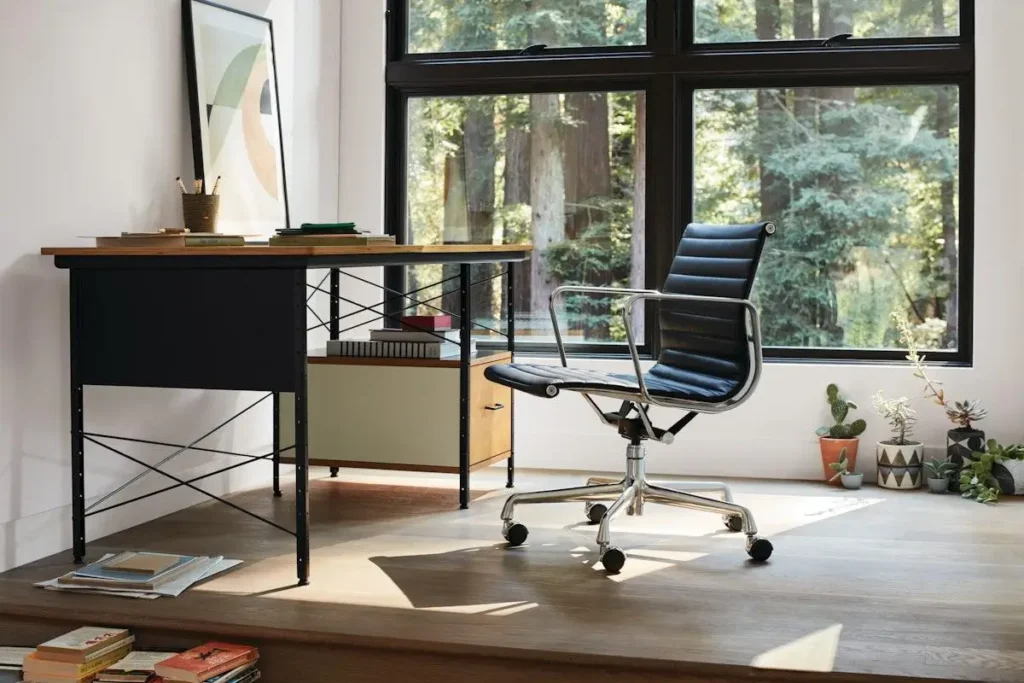
Our versions have fixed arms and no lumbar or seat-depth adjustment. So the honest version is this: an Eames-style chair is a design office chair, not a task chair. Our history of the Eames Aluminium Group covers the design story.
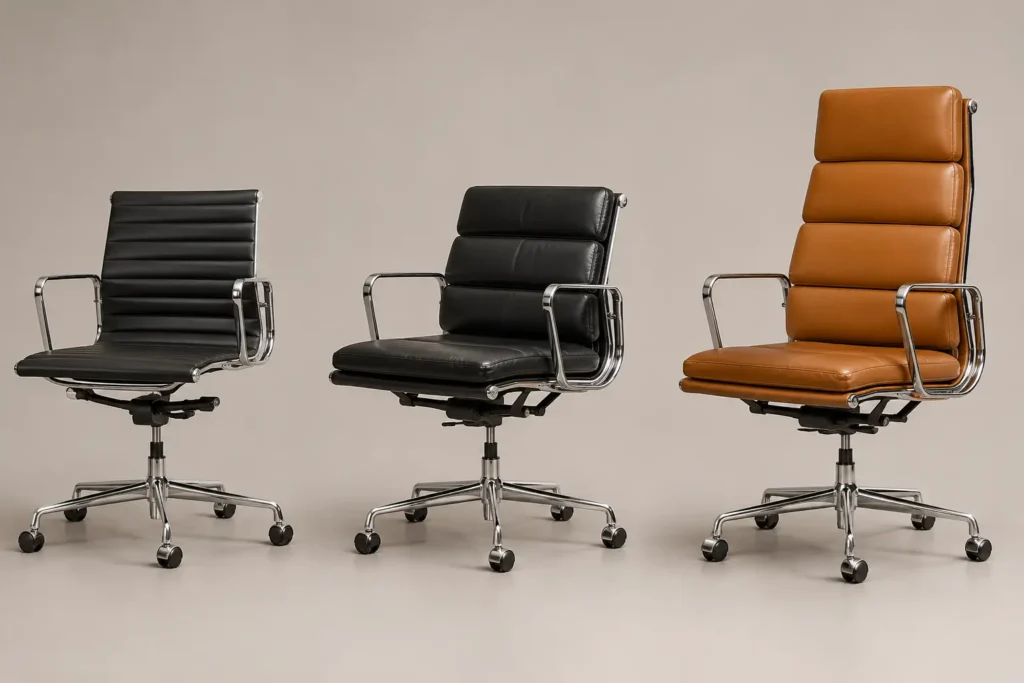
- The EA117 thin pad ribbed chair has slim ribbed cushions for a firmer seat.
- The EA217 soft pad chair has thicker sewn-on cushions for a softer one. Our EA217 vs EA117 comparison goes into detail.
- The EA219 high back soft pad chair adds a taller back, about 59 cm from seat to top.
Executive chairs
An executive chair puts cushioning and presence ahead of adjustment. Our ES104 executive lobby chair has three tufted leather cushions, height adjustment and tilt, with a fixed back and arms. Its deep seat favours leaning back, which suits calls and meetings more than hours of typing.
How do these office chair types compare?
| Option | Best for | Main advantage | Limitation |
|---|---|---|---|
| Ergonomic task chair | Long, unbroken sessions | Seat depth, lumbar and arm adjustment | Bulky, mostly plastic |
| Eames-style low back (EA117, EA217) | Home offices, broken-up days | Slim profile, leather and aluminium | Fixed arms, narrow seat height range |
| Eames-style high back (EA219) | Taller users | More upper-back support | Fixed arms, no headrest |
| Executive (ES104) | Client offices, calls | Deep three-cushion comfort | Relaxed posture, 74 × 69 cm footprint |
| Mesh office chair | Warm rooms | Airflow | Mesh can sag over time (Which?, 2026) |
Are Eames-Style Office Chairs Comfortable for Long Hours?
Yes, for home-office sessions of an hour or two with breaks between them. No, if your job keeps you upright in one seat most of the day. An Eames-style chair gets seat height and tilt right, but it can’t fine-tune itself to your body the way a task chair can.
The numbers show why. Our EA217 and EA219 list a seat height of 48 to 57 cm, a 9 cm range. EN 1335-1 asks for at least 13 cm of travel on a Type A chair and 10 cm on a Type B (CATAS, 2024). A narrower range fits a narrower band of leg lengths, so measure before you buy.
Where they do well is everything else. The sling seat gives a little under your weight, the tilt lets you lean back between tasks, and a 59 × 63 cm footprint suits small home offices. For warmer rooms, an Eames mesh office chair swaps leather for an open mesh back.
Which Buying Factors Matter Most for Desk Chair Comfort?
Seat height, seat depth and lower-back support matter most for desk chair comfort, followed by armrests and upholstery. Use this table as a short ergonomic office chair guide before you compare models.
| Factor | What to look for | Who needs it most |
|---|---|---|
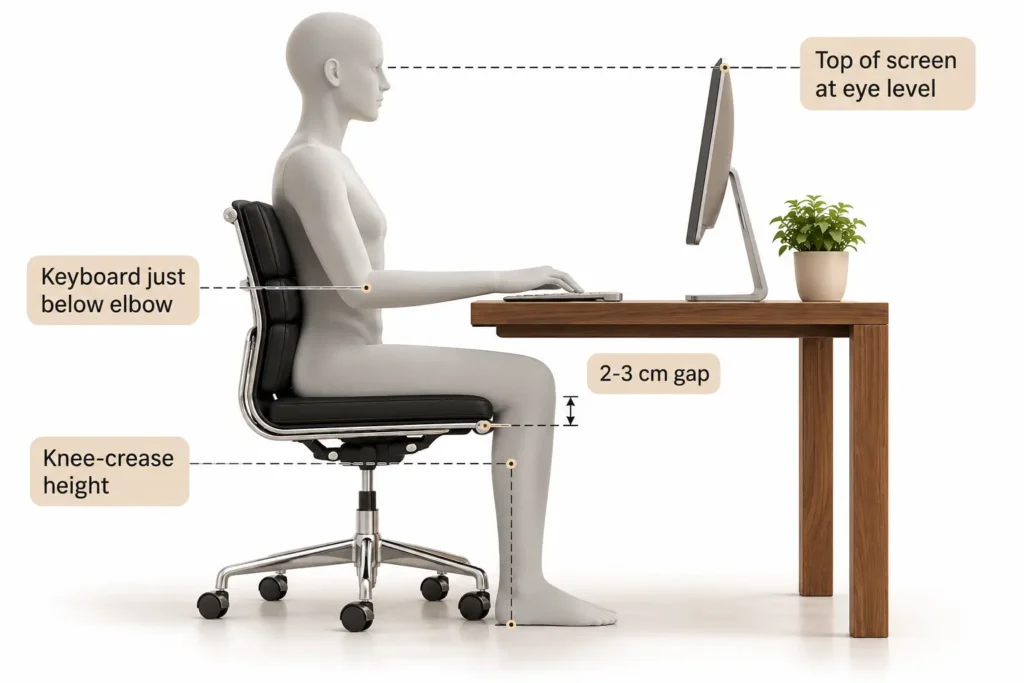
| Seat height range | A range that includes your knee-crease height, so the seat supports the front and back of your thighs equally (HSE, 2025) | Short and tall users |
| Seat depth | A 2 to 3 cm gap between the seat edge and the back of your knee (HSE, 2025) | Short or long thighs |
| Lower-back support | Adjustable lumbar, or a backrest that meets your lower back; add a cushion if not | Long, unbroken sessions |
| Armrests | Arms that let your shoulders drop and sit level with or below the desk edge | Heavy typing |
| Upholstery | Mesh breathes; leather costs more and can scratch or crack (Which?, 2026) | Warm rooms |
| Warranty and returns | A written warranty and a return window long enough to test the fit | Online buyers |
Our office chairs carry a 2-year written warranty, and you have 14 days from delivery to return one.
How Do You Check If an Office Chair Fits Your Body?
Check fit in four steps, starting with a tape measure before you order. Online, your measurements replace the showroom test.
- Measure your knee-crease height. Sit on a firm chair in your shoes, feet flat, then measure from the floor to the crease behind your knee. The chair’s seat height range should include this number.
- Check seat depth. Sitting right back, leave 2 to 3 cm between the seat front and the back of your knee.
- Check your lower back. The backrest should support it. If it doesn’t, a small cushion fills the gap.
- Set your desk. Keep the keyboard just below elbow height and the top of the screen level with your eyes, about an arm’s length away, as the HSE posture guidance sets out (HSE, 2025).
What if you’re short, or big and tall?
If your feet don’t rest flat at the lowest setting, use a footrest. Our soft pad chairs start at 48 cm, so shorter users should measure first. Tall users should check the top of the range (57 cm) and consider the EA219’s higher back. Bigger users should ask any seller, us included, for the tested weight rating before ordering.
Which Office Chair Should You Choose for Your Working Day?
Match your need to the feature that answers it, then to the chair type.
- You sit all day in long stretches. An all day office chair for that pattern needs seat-depth and lumbar adjustment, so buy a task chair. This is the one case where we’d point you away from our range.
- You work from home with calls and breaks. You need the right seat height and tilt in a chair that suits your home, so pick the EA117 for a firmer seat or the EA217 for a softer one.
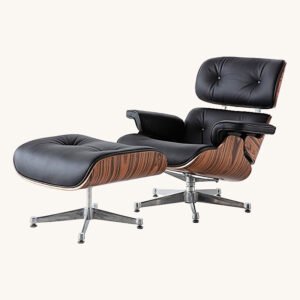
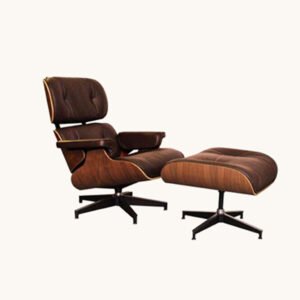
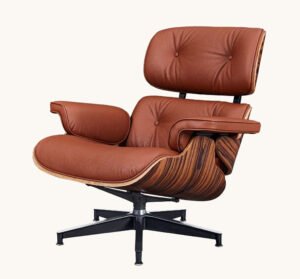
- You want a chair with a leg rest. Pull-out leg rests are built for reclining, which moves you away from the keyboard. Two chairs work better: an office chair at the desk and an Eames lounge chair and ottoman replica for reading and breaks.
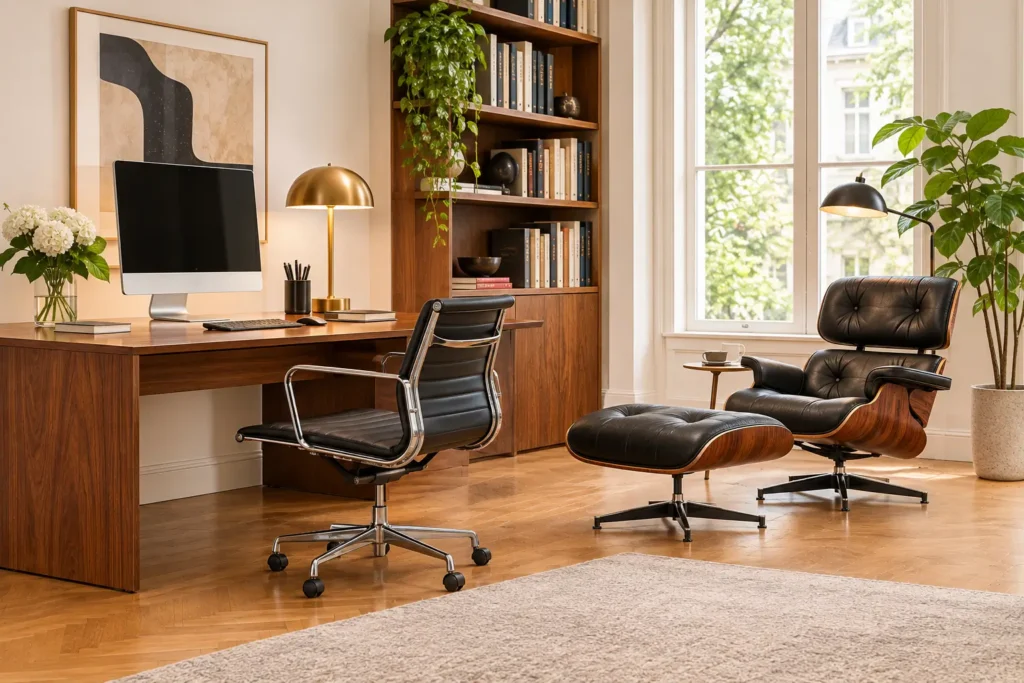
Planning the whole room? Our guide to a mid-century home office setup shows how these chairs fit into a working space.
How Much Should You Spend on an Office Chair for Long Hours?
Spend enough to get the adjustments your body needs, and no more. The Guardian’s office chair test ran from £38.99 to £1,399 for the Herman Miller Aeron (The Guardian, 2025), and Which? puts most chairs at about £60 to over £800 (Which?, 2026).
- Under £100, expect basic height and tilt. The Guardian’s budget pick had a fixed back and fixed arms.
- UK Vitra stockists list the original Soft Pad Chair EA 217 at roughly £3,770 to £4,685, depending on finish (Utility Design and Really Well Made, 2026).
- Our replicas sell at €319 for the EA217, €325 for the EA117, €339 for the EA219 and €385 for the ES104 (sale prices, November 2026).
Price rises with the tilt mechanism, frame material, upholstery, testing and, for originals, the maker’s name. A costly chair set to the wrong height still won’t feel right.
What Mistakes Should You Avoid When Buying a Chair for Long Hours?
The most common mistakes are choosing on looks, ignoring the lowest seat height and expecting a chair to replace breaks.
- Choosing on looks alone. A chair that can’t adjust to you is a poor work tool, ours included. Pick an Eames-style chair because it fits your body and your day.
- Ignoring the lowest seat height. A seat that starts too high leaves your feet dangling and presses under your thighs.
- Judging comfort in five minutes. Soft padding feels best at first, but a seat that holds its shape matters more by mid-afternoon. Test it through real working days.
- Expecting the chair to replace breaks. Breaks should let you get up and move, or at least stretch and change posture, says the HSE break guidance (HSE, 2025).
How We Researched This Guide
We read the UK and EU buying guides ranking for this search, then checked the DSE Regulations, HSE guidance and EN 1335-1. Every spec for our chairs comes from our product pages. We sell Eames-style chairs as design-led office chairs, not as EN 1335-certified work chairs.
Frequently Asked Questions About Office Chairs for Long Hours
What is the best office chair for long hours?
The best office chair for long hours is one whose seat height, seat depth, back support and arms you can set to your body. For long, unbroken sessions, choose a fully adjustable task chair. For home offices with regular breaks, a well-made Eames-style chair at the right seat height works well.
Is a leather office chair good for long hours of sitting?
A leather office chair works for long hours if it fits your body. Leather costs more than mesh and can scratch or crack, while mesh breathes better in warm rooms (Which?, 2026).
How often should you get up from your office chair?
Get up for a short break every hour. The HSE says 5 to 10 minutes every hour is better than 20 minutes every 2 hours (HSE, 2025).
Is a high-back or low-back office chair better for long hours?
A high-back chair is better if you’re tall or lean back often, because it supports more of your upper back. A low-back chair suits people who sit upright. Neither makes up for the wrong seat height.
Do I need an EN 1335 certified office chair at home?
No. EN 1335 is a voluntary European standard, and the UK DSE Regulations place duties on employers. If you’re employed and work from home, ask your employer about a workstation assessment.
Are Eames office chairs good for back pain?
Our Eames-style chairs have no adjustable lumbar support, so they aren’t the first choice if you already have back pain. Follow your GP’s or physiotherapist’s advice, and consider a fully adjustable task chair.
Find an Eames Style Office Chair That Fits Your Day
If your working day has natural breaks and you want a chair that suits your home as well as your desk, browse our Eames style office chair collection. Measure your knee-crease height first, compare it with the seat height on each product page, then test the fit at your own desk.
Follow Sederica in Google
Add us as a preferred source and our buying guides will appear more often in your Google results.
Add as preferred source