Charles and Ray Eames
A husband and wife team who spent nearly forty years turning new materials into furniture that ordinary people could live with. Their work shapes almost everything we make.
At a Glance
| Full names | Charles Ormond Eames Jr. and Ray Kaiser Eames, born Bernice Alexandra Kaiser |
|---|---|
| Born and died | Charles: St. Louis, 1907 to 1978. Ray: Sacramento, 1912 to 1988. |
| Nationality | American |
| Working together | Married 1941. The Eames Office ran from 1943, in Los Angeles. |
| Best known for | Moulded plywood chairs, fibreglass shell chairs, and the 1956 lounge chair and ottoman |
| Originals made by | Herman Miller in the United States, Vitra in Europe |
| See originals at | MoMA (New York), Vitra Design Museum (Weil am Rhein), V&A (London) |
| Sederica pieces | Lounge chairs, office chairs, dining chairs, rocking chairs |
Who Were Charles and Ray Eames
Two very different talents, working as one
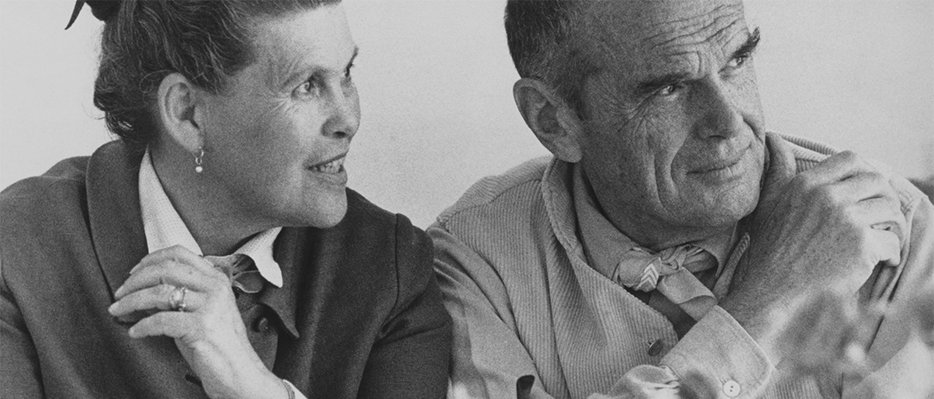
Charles Ormond Eames Jr. was born in St. Louis in 1907. He studied architecture at Washington University but did not finish the course, and worked in Missouri for a few years. The architect Eliel Saarinen then invited him to the Cranbrook Academy of Art in Michigan, where he became head of the industrial design department. Eliel's son was Eero Saarinen, who became Charles's closest collaborator.
Ray Kaiser was born in Sacramento in 1912. She trained as a painter and studied for years under the German abstract artist Hans Hofmann in New York, where she exhibited with the American Abstract Artists group. After her mother died she enrolled at Cranbrook, where Charles was one of her teachers.
They met there in September 1940, when Ray helped prepare drawings for a design competition Charles had entered. They married in 1941 and moved to Los Angeles. By 1943 they were working out of a converted garage, and that garage became the Eames Office.
"Equally responsible with me for everything."
Charles Eames, on RayFor decades the credit went almost entirely to Charles, because he gave the interviews and appeared on television. The public assumed he was the lone talent and Ray was his assistant. She was not, and Charles said so throughout his life. The line above is how he put it. Ray shaped the proportions, the colour and the finish of the furniture, designed covers for Arts and Architecture magazine, and art directed the films.
Asked once to describe her own role, Ray gave the shortest possible answer: "I don't know how to separate anything." The projects were built together from start to finish. We name them both, in that order, because that is how the work was made.
Charles died of a heart attack on 21 August 1978, aged 71, while visiting St. Louis. Ray died on 21 August 1988, ten years later to the day. They are buried side by side.
The Work, Year by Year
Four decades, told in eleven moments
A competition win with a friend
Charles entered the Museum of Modern Art's Organic Design in Home Furnishings competition with Eero Saarinen, and Ray helped prepare the entry. They won first prize. The problem was that no factory could yet make the shape they had drawn.
Leg splints for the US Navy
Charles and Ray built a plywood press in the spare room of their flat and nicknamed it the Kazam! machine. Wounded sailors needed splints that curved to fit a leg. The Navy ordered 5,000. Learning to bend plywood in three directions taught them how to make a chair.
The Eames Elephant
A child's seat in moulded plywood, made with the same press as the splints. They treated work for children as seriously as work for adults.
The plywood chairs reach the public
MoMA showed their experimental furniture, and Herman Miller began producing Eames designs from its factory in Zeeland, Michigan. The LCW, which stands for Lounge Chair Wood, went into production. See our plywood chair collection.
They build their own house
Case Study House No. 8, in Pacific Palisades, was assembled from parts ordered out of industrial steel catalogues. They lived in it for the rest of their lives. It still stands, and is preserved as a museum.
The shell chair goes into mass production
A single moulded seat shell in fibreglass, fitted to whatever base you needed. Wooden dowel legs made the DSW and DAW. Wire legs made the DSR and DAR. Curved runners made the RAR rocking chair. One shape, many chairs.
Toys, made with the same care
The House of Cards building set arrived in 1952, and Ray designed the Hang-It-All coat rack in 1953. Both were sold as playthings, and both were designed with the same attention as the chairs.
The lounge chair and ottoman
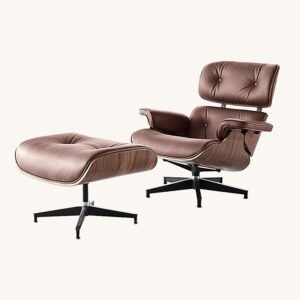
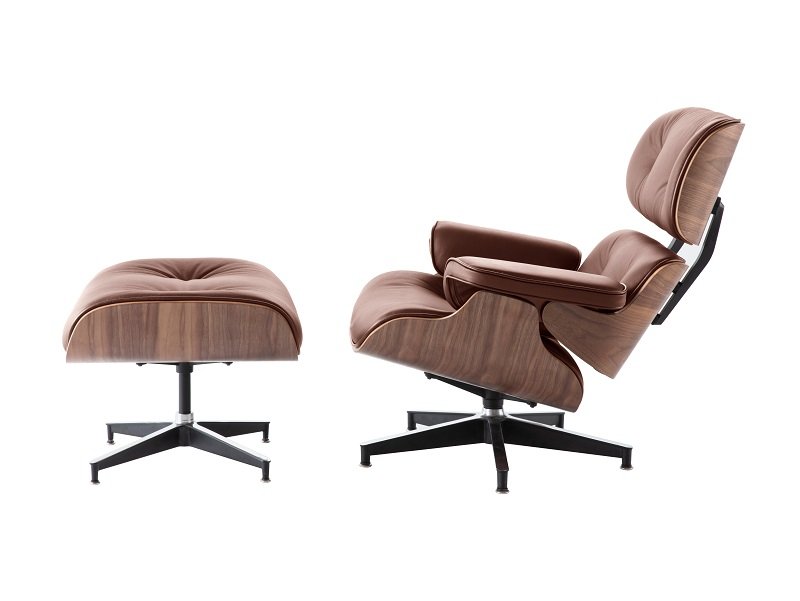
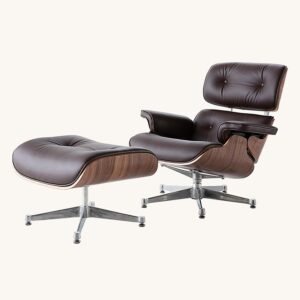
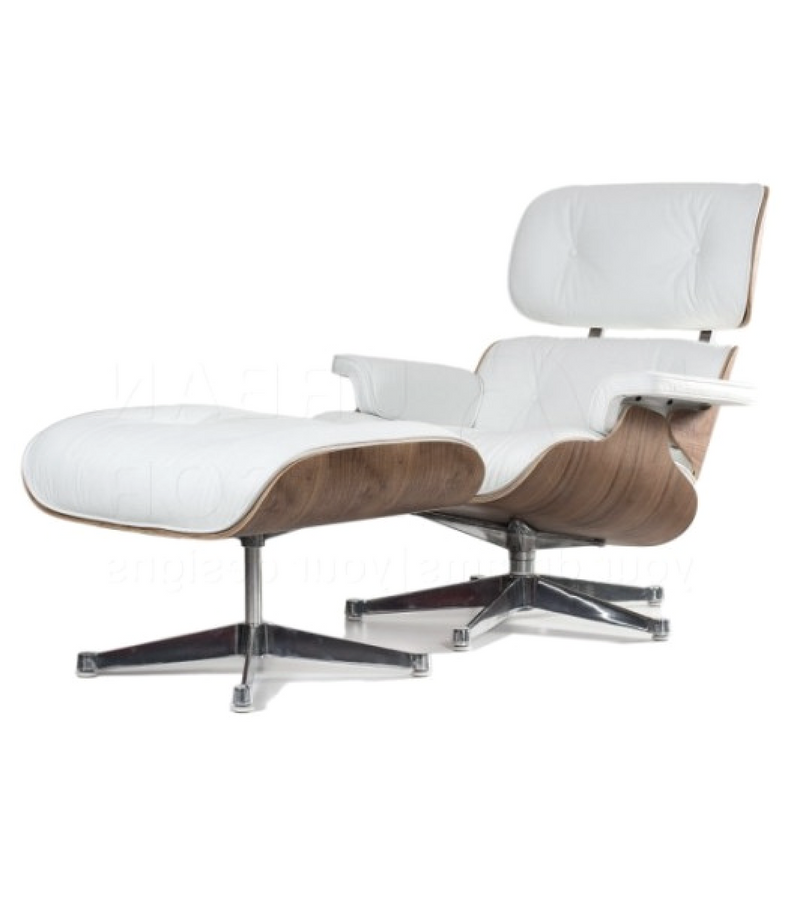
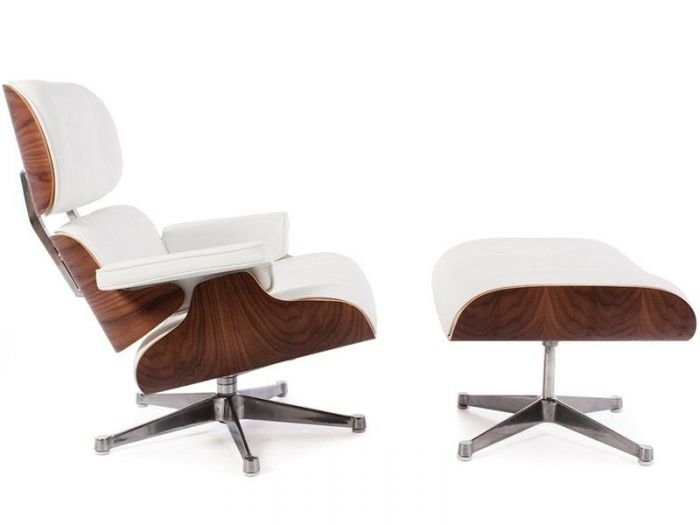
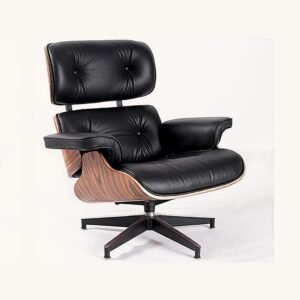
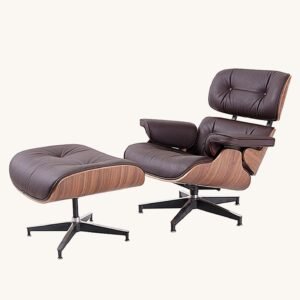
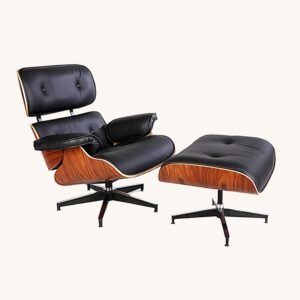
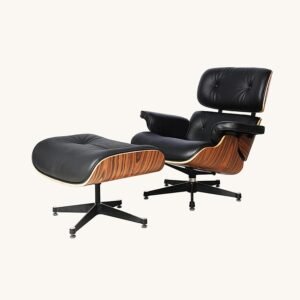
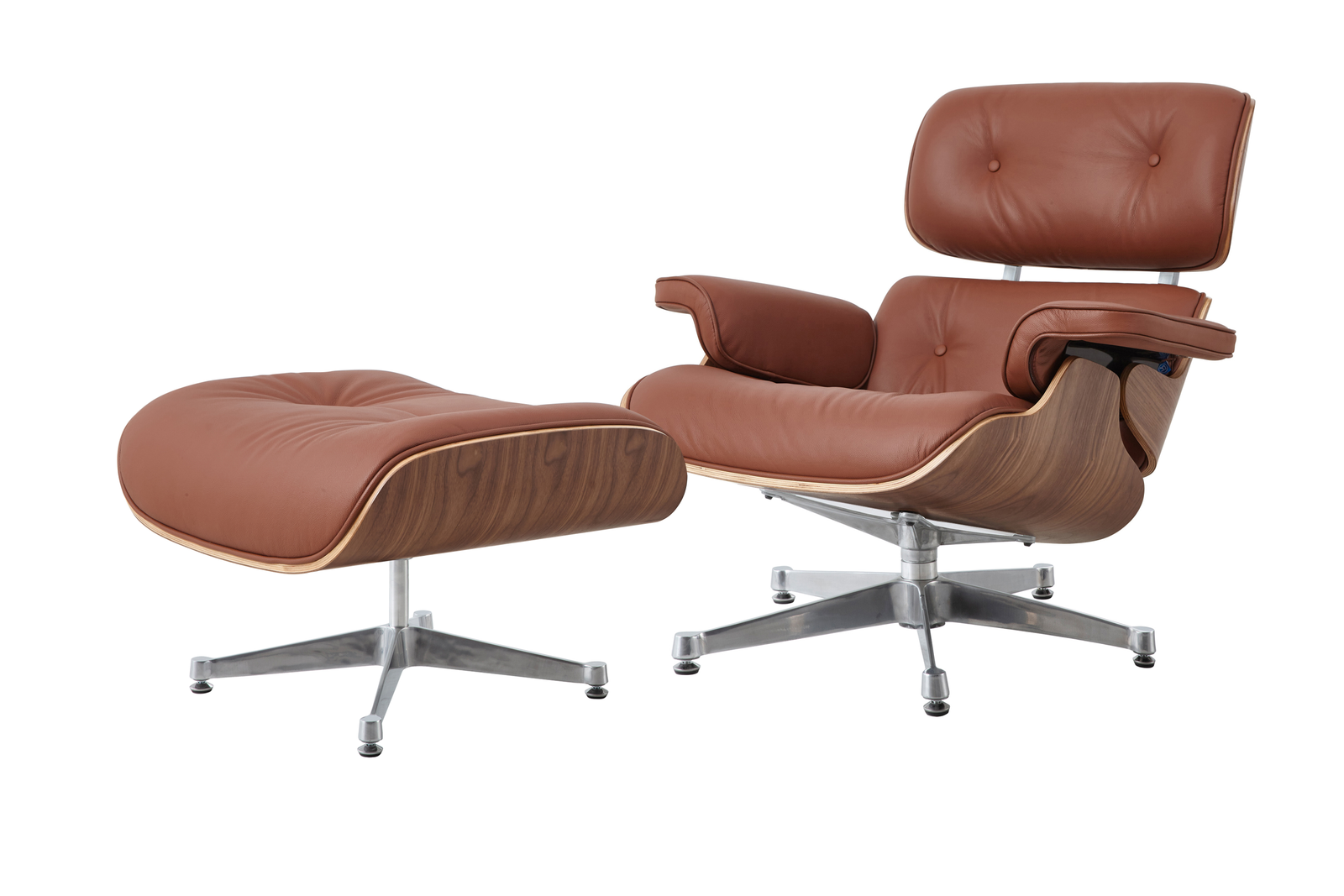
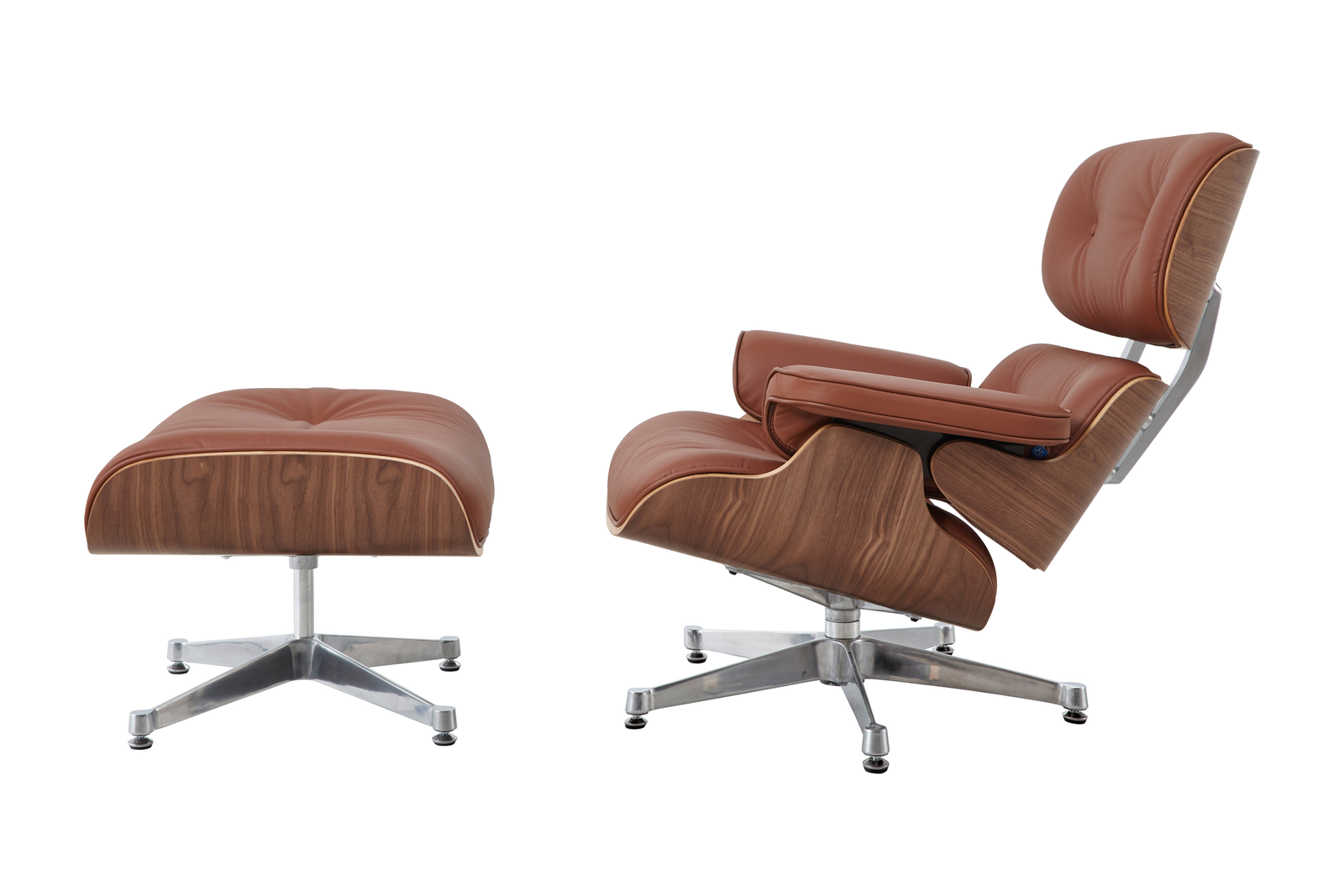
Models 670 and 671. Three curved plywood shells, thick leather cushions, a five star aluminium base. Charles wanted it to have the warm, welcoming look of a well-used baseball mitt. It remains the piece most people picture when they hear the name Eames.
The Aluminium Group
Designed for the Miller House in Columbus, Indiana. Instead of a shell, fabric or leather is stretched between two aluminium side ribs. It became the office chair of the 1960s and 1970s.
The Soft Pad Group
The same aluminium frame, now with deep sewn cushions. Their colleague Alexander Girard had asked for something softer to sit on all day. See our office chair collection.
Powers of Ten
The Eames Office made around 100 short films. This nine minute one, which zooms from a picnic in Chicago out to the edge of the universe and back into a single atom, is still shown in classrooms today.
Ray saves the archive
After Charles died, Ray ran the office for another ten years. She finished outstanding projects, advised IBM, and sorted roughly 1.5 million drawings, prints and photographs, which she gave to the Library of Congress so the studio's work would survive.
Signature Materials and Techniques
What they built with, and why it mattered
Charles and Ray did not decorate furniture. They asked what a material could do that it had never done before, then built the machine to find out. Four methods run through most of their work.

Moulded plywood
Thin layers of wood, glued and pressed into curves that run in more than one direction at once. Nobody had done this at scale before. It gave their chairs a shape that follows the body without any padding at all.
Rubber shock mounts
Small rubber discs that join the plywood seat to its frame. They let the seat flex slightly as you sit, and they stop the wood from cracking at the fixing points. A small part that solved a real problem.
Fibreglass shells
In 1950 they moved the shell chair from metal to fibreglass reinforced polyester, and it became one of the first plastic chairs made in real numbers. One mould, one shape, dozens of finished chairs.
Cast aluminium
Polished die-cast aluminium gave them a base that was light, strong and thin enough to almost disappear under the seat. It carries the 1956 lounge chair and the whole Aluminium Group.
We use the same family of materials in our own work: real wood veneers, full-grain leather, and polished die-cast aluminium bases. You can read how each piece goes together in our assembly guide.
More Than Furniture
Houses, films and toys from the same studio
Charles and Ray were never only furniture designers, and that range is a large part of why their name carries the weight it does.
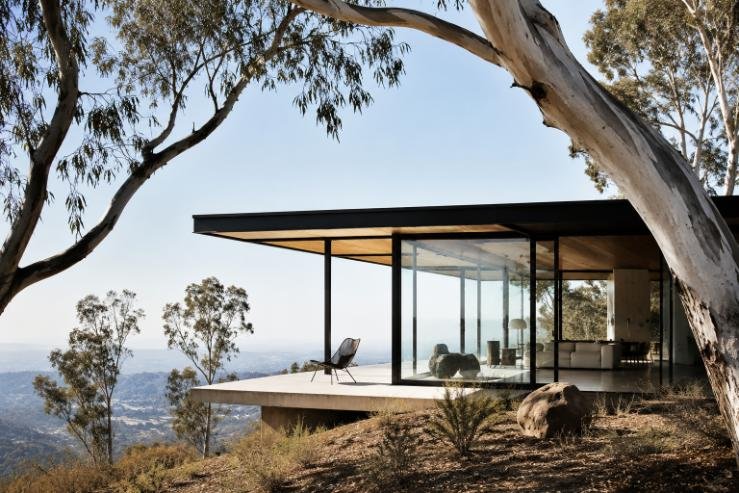
Architecture. In 1949 they built the Eames House as part of the Case Study House programme run by Arts and Architecture magazine. It went up quickly, from off-the-shelf steel parts, and became a landmark of modern building.
Film. The Eames Office made around 100 short films. Powers of Ten is the best known. They also made Glimpses of the U.S.A., shown on seven screens at the American National Exhibition in Moscow in 1959.
Toys. The moulded plywood Elephant came in 1945, the House of Cards set in 1952, and Ray's Hang-It-All coat rack in 1953. These were sold to children and made with the same care as anything else that left the studio.
What They Believed About Design
Three ideas that shaped the work
"The details are not the details. They make the design."
Charles EamesThe first idea was that good design should reach as many people as possible. The Eames Office described its aim as getting the best to the greatest number of people for the least. That is why the shell chair was made to be cheap, stackable and sold by the thousand.
The second idea was that a designer solves problems rather than adds decoration. The splint came before the chair. The chair came out of the splint. Every curve had a reason behind it.
The third idea was that the work should be enjoyable. Charles said you should take your pleasure seriously. That belief runs through the toys, the films and the exhibitions as much as the furniture.
We think about the first idea most. The licensed originals now cost several thousand euros, which puts them out of reach for most homes. Making a careful replica is our answer to that, and we are honest about what it is. You can read where the line falls in our guide to originals, replicas and reproductions.
Iconic Pieces in Our Collection
Our tributes to their work, made honestly as replicas
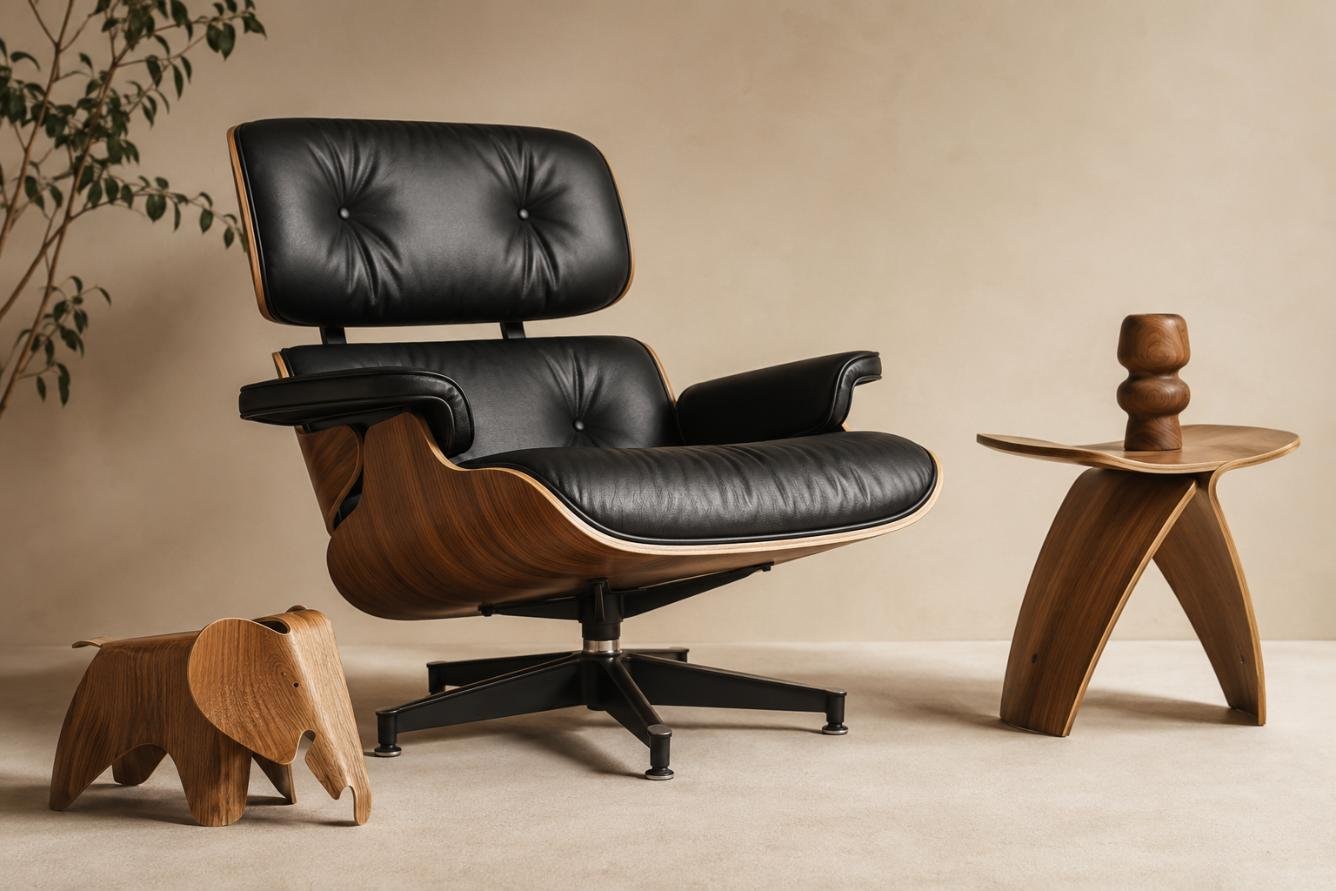
Every piece below is a Sederica reproduction. We are not connected to Herman Miller, Vitra, or the Eames family, and we do not claim to be. What we offer is the shape, the proportions and the comfort of these designs, made with quality materials at a price that suits a real home.