
Ludwig Mies van der Rohe
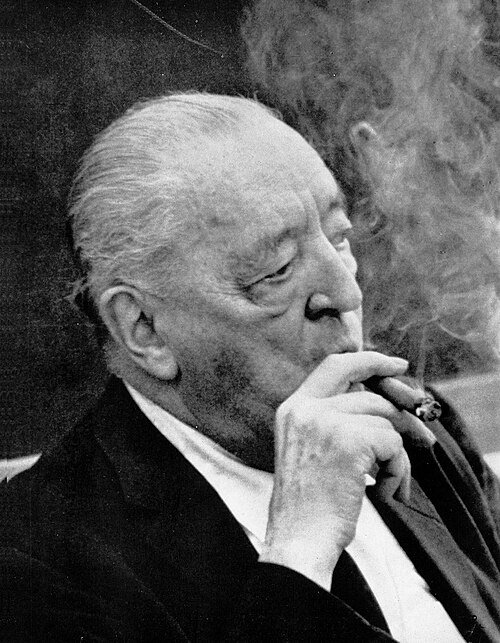
A stonemason's son who stripped buildings back to steel, glass and open space. With Lilly Reich he designed a chair for a world's fair pavilion in 1929, and it has never gone out of production since.
At a Glance
| Full name | Maria Ludwig Michael Mies. He added his mother's surname, Rohe, in the early 1920s. |
|---|---|
| Born and died | Aachen, Germany, 1886. Died in Chicago, 1969. |
| Nationality | German, later American |
| Design partner | Lilly Reich (1885 to 1947), who worked with him from the mid-1920s until 1939 |
| Best known for | The Barcelona chair, the Brno chair, the Barcelona Pavilion, and the phrase "less is more" |
| Originals made by | Knoll, which has produced the Barcelona chair since 1953 |
| See originals at | The Barcelona Pavilion (Spain), Villa Tugendhat (Czech Republic), MoMA (New York) |
| Sederica pieces | Barcelona style chairs, ottomans and sets |
Who Was Mies van der Rohe
A stonemason's son who never studied architecture
He was born in Aachen in 1886 and learned to draw in his father's stone workshop. He never took an architecture degree. What he had instead was an eye for how materials meet, which he picked up by watching stone being cut.
In 1908 he joined the Berlin office of Peter Behrens. Walter Gropius and Le Corbusier worked in the same office around that time. In the early 1920s he added his mother's surname, Rohe, and the Dutch "van der" to his own name. Ludwig Mies became Mies van der Rohe.
He ran the Bauhaus from 1930 until the Nazis forced it to close in 1933. He left Germany for Chicago in 1938 and spent the rest of his life there, teaching and building in steel and glass.
Lilly Reich, the Partner Nearly Written Out
The name that belongs beside his
Lilly Reich was born in Berlin in 1885, three years before Mies. She was a designer of textiles, furniture, interiors and exhibitions. She was the first woman elected to the board of the German Werkbund. She ran a workshop at the Bauhaus. She is the only woman credited with designing a complete tubular steel furniture range for the Bamberg Metallwerkstätten.
She and Mies worked together from the mid-1920s until 1939. The Glasraum at the 1927 Stuttgart exhibition was theirs. The Barcelona Pavilion was theirs. Villa Tugendhat was theirs. So were the chairs that came out of those buildings.
The Fundació Mies van der Rohe, which looks after the Barcelona Pavilion, describes Lilly Reich as the artistic partner of Mies in the conception and execution of the German Pavilion of 1929. Not an assistant. A partner.
After Mies left for the United States, her name faded from the story. She stayed in Germany through the war and died in Berlin in 1947, at 62. Historians have spent the decades since putting her name back where it belongs. We write both names because both did the work.
The Work, Year by Year
Six decades, told in eight moments
He joins Peter Behrens in Berlin
Behrens designed everything for the electrical company AEG, from factories to kettles. Mies learned there that a building and the objects inside it should be thought about together.
The Glasraum with Lilly Reich
At the Stuttgart Werkbund exhibition they built a room out of glass panels, with no fixed walls. The same year came the MR20, an early tubular steel chair that built on work by the Dutch designer Mart Stam.
The Barcelona Pavilion and its chair
The German national pavilion for the Barcelona International Exposition, built from glass, steel and several kinds of marble. Mies and Reich designed the chair as part of the building itself, and only two were made. They were placed as fixed elements of the room rather than as furniture to be moved about.
Villa Tugendhat and two more chairs
A house in Brno, in what is now the Czech Republic. For the bedroom they designed the Brno chair, model MR50. For the living room came the Tugendhat chair, model MR70. Both use a single curved steel bar instead of four legs.
Director of the Bauhaus
He took over the school from Hannes Meyer. Lilly Reich taught there as one of his assistants. The Nazis forced it to close three years later.
He leaves for Chicago
He took a teaching post at what became the Illinois Institute of Technology. Reich stayed in Berlin. Their working partnership ended.
Knoll begins production
The Barcelona chair had been made only in small numbers until then. Knoll took it into proper production and has made it ever since. See our Barcelona style collection.
The Pavilion comes back
The original was taken down in 1930, months after the exposition closed. In 1986 it was rebuilt on the same site in Barcelona, using the same materials. You can walk through it today.
Signature Materials and Techniques
Four things that make a Barcelona chair what it is
There is very little to a Barcelona chair. That is the whole point. Every part has to be right, because there is nothing to hide behind.
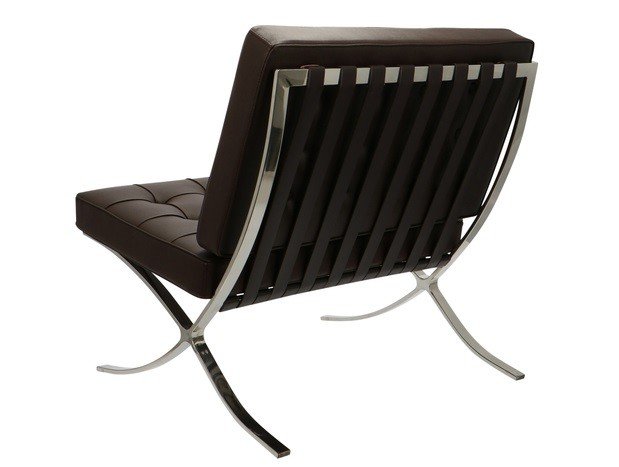
The crossed steel frame
Two curved bars cross in the middle, one carrying the seat and one carrying the back. The shape comes from the folding stools Roman and Egyptian officials once sat on. It is an old idea drawn in modern steel.
Hand-welded joints
The frame is not bolted together. The bars are welded, then ground and polished until the joint disappears. On a good chair you cannot find where one bar ends and the next begins.
Leather support straps
The cushions do not sit on a solid base. They rest on leather straps stretched across the frame, which give slightly as you sit and let air move through. This is why the chair looks so light from the side.
Tufted leather cushions
Each cushion is built from individual leather panels, sewn together and pulled down with buttons at each join. The tufting is what gives the surface its squared pattern.
We build our version the same way, with a polished stainless steel frame and full-grain leather cushions on leather straps. Because there is no complicated joinery, setting one up takes about ten minutes and needs no tools. Our assembly guide walks through it.
What He Believed About Design
Two short phrases that carried a whole way of working
"Less is more."
Ludwig Mies van der RoheHe did not invent that line. It appears in a Robert Browning poem from 1855. Mies made it the rule he worked by. Take things away until nothing is left that does not need to be there, then make what remains as good as it can be.
His other line was that God is in the details. The two ideas belong together. If you strip a chair back to two steel bars and two cushions, the weld on those bars has to be perfect, because it is one of the few things left to look at.
This is also why the Barcelona chair is so hard to copy badly without it showing. There is no pattern, no carving and no cover to distract the eye. You are looking straight at the steel and the leather. We chose to make one because we thought we could make that honestly, and we tell you plainly that ours is a replica.
Iconic Pieces in Our Collection
Our tributes to their work, made honestly as replicas
Every piece below is a Sederica reproduction. We are not connected to Knoll or to the estates of Mies van der Rohe or Lilly Reich, and we do not claim to be. What we offer is the shape, the proportions and the comfort of the design, made with quality materials at a price that suits a real home.
Barcelona Chair and Ottoman
-
Barcelona Chair Replica, Barcelona Chair with Ottoman
Original price was: €979,00.€669,00Current price is: €669,00. Add to basket -
Barcelona Chair Replica, Barcelona Chair with Ottoman
Original price was: €979,00.€629,00Current price is: €629,00. Add to basket -
Barcelona Chair Replica, Barcelona Chair with Ottoman
Original price was: €979,00.€629,00Current price is: €629,00. Add to basket -
Barcelona Chair Replica, Barcelona Chair with Ottoman
Original price was: €979,00.€629,00Current price is: €629,00. Add to basket -
Barcelona Chair Replica, Barcelona Chair with Ottoman
Original price was: €979,00.€655,00Current price is: €655,00. Add to basket -
Barcelona Chair Replica, Barcelona Chair with Ottoman
Original price was: €979,00.€629,00Current price is: €629,00. Add to basket
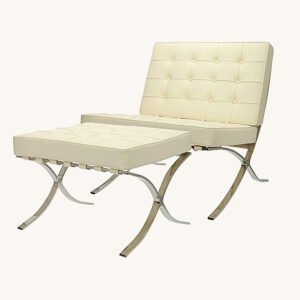

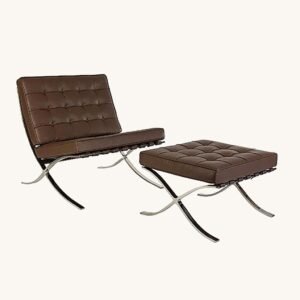
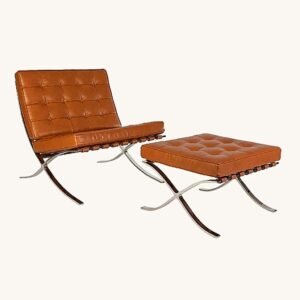
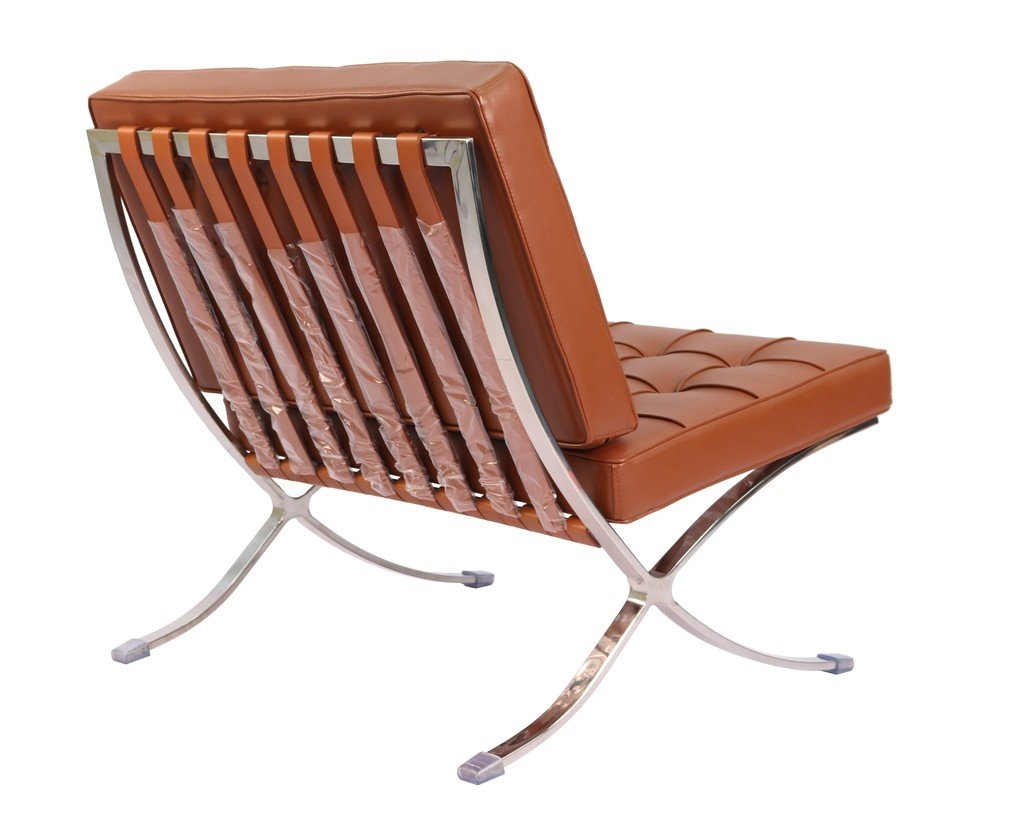
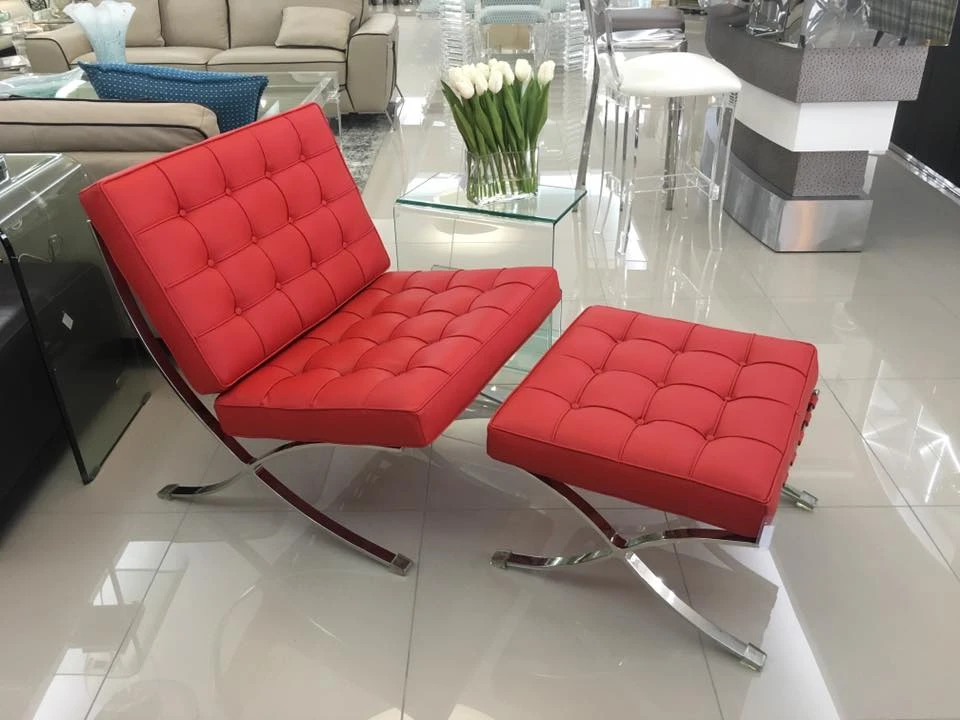
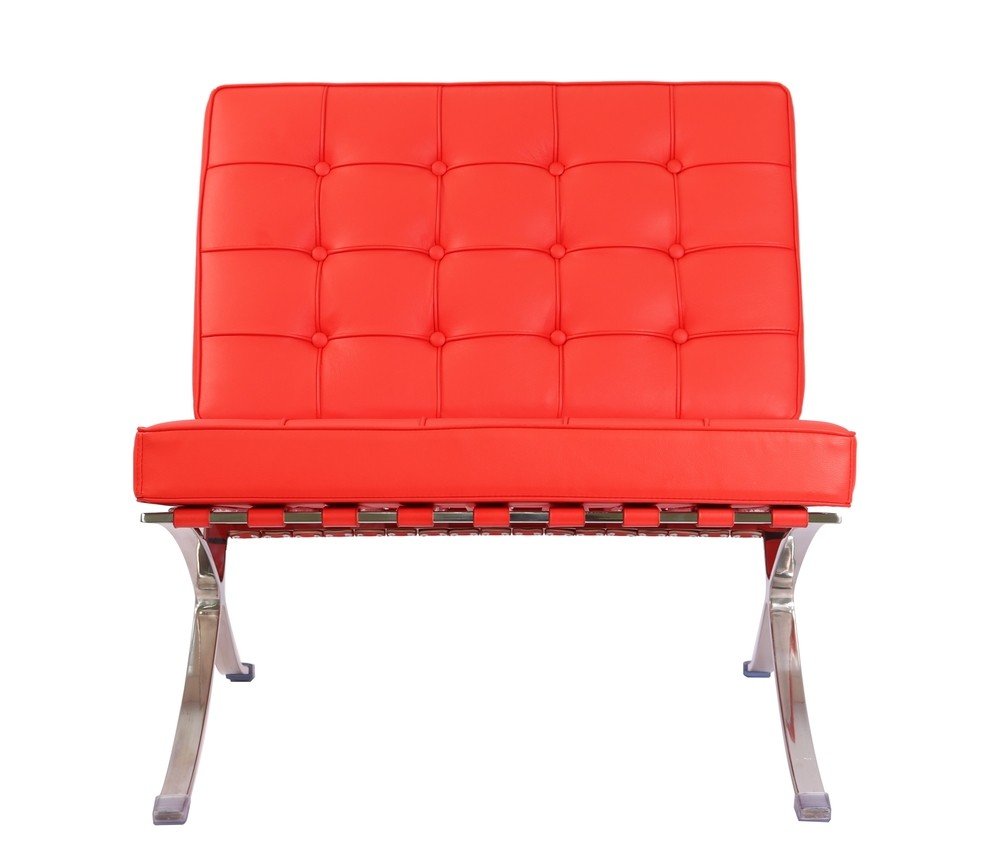
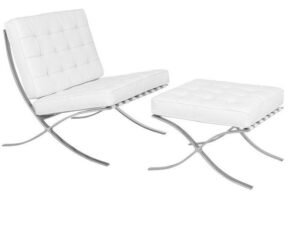

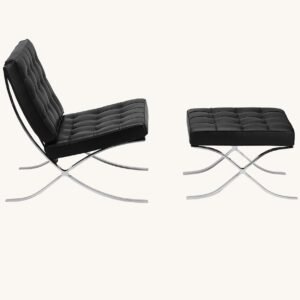

See the full set range on our Barcelona chair and ottoman page.
Barcelona Chair on Its Own
See every colour on our single Barcelona chair page .
Where to See the Originals
Three of these are in Europe, within reach of a weekend
The licensed originals are made by Knoll. If you want to see the chair in the room it was designed for, the Pavilion in Barcelona is the place to go.
The Barcelona Pavilion
Barcelona, Spain. Rebuilt in 1986 on the original site, with Barcelona chairs in place.
Villa Tugendhat
Brno, Czech Republic. A UNESCO World Heritage site, and the home the Brno chair was made for.
Neue Nationalgalerie
Berlin, Germany. His last European building, finished in 1968, a year before he died.
Museum of Modern Art
New York, United States. Holds Barcelona and Brno chairs in its design collection.
Questions People Ask About Mies van der Rohe
Short, factual answers
Who designed the Barcelona chair?
Ludwig Mies van der Rohe and Lilly Reich designed it together in 1929 for the German Pavilion at the Barcelona International Exposition. For many years the credit went to Mies alone. The Fundació Mies van der Rohe now describes Reich as his artistic partner on that project.
Did Lilly Reich co-design the Barcelona chair?
Yes. Reich worked with Mies on the whole Barcelona Pavilion project, including its furniture. Her name was left off much of the early credit after Mies emigrated to the United States. Design historians have been correcting the record since the 1990s, and the official foundation now names her.
Why is it called the Barcelona chair?
It is named after the 1929 Barcelona International Exposition, where it first appeared in the German Pavilion. Mies and Reich designed the chairs as fixed parts of the building rather than as furniture to be moved around, and only two were built.
When was the Barcelona chair designed?
1929. It was made only in small numbers at first. Knoll began producing it properly in 1953 and has made it ever since. Our Barcelona chair history guide covers the full timeline.
What does "less is more" mean?
It means removing everything a design does not need, then making what is left as good as possible. Mies made the phrase famous, though it comes from a poem by Robert Browning written in 1855.
Is the Barcelona chair comfortable?
It is comfortable for sitting and talking rather than for lying back. The seat is low and firm, the back is upright, and the leather straps give a little as you settle. It was designed as a chair to receive guests in, not a chair to fall asleep in.
Who makes the original Barcelona chair today?
Knoll holds the licence and has produced it since 1953. Replicas like ours are made independently and are not licensed by Knoll. You can read more about that difference in our guide to originals, replicas and reproductions.
Designers in the Same Story
Their contemporaries and rivals
Le Corbusier
Worked in the same Berlin office as Mies. His studio produced the LC4 chaise longue in 1928.
Charles and Ray Eames
The Americans who took modernist ideas into ordinary homes after the war.
Eero Saarinen
Another architect who designed chairs, and whose Tulip chair sought the same simplicity.
Sources
- Fundació Mies van der Rohe, the Pavilion and Lilly Reich, miesbcn.com
- Museum of Modern Art, Mies van der Rohe collection, moma.org
- Knoll, Barcelona collection and production history, knoll.com
- Villa Tugendhat, official site and UNESCO listing, tugendhat.eu
Bring the Shape Home
Free delivery across Europe and the United Kingdom in 4 to 7 working days, with a 2-year written guarantee and 14 days to change your mind.
Shop the Collection