
TL;DR
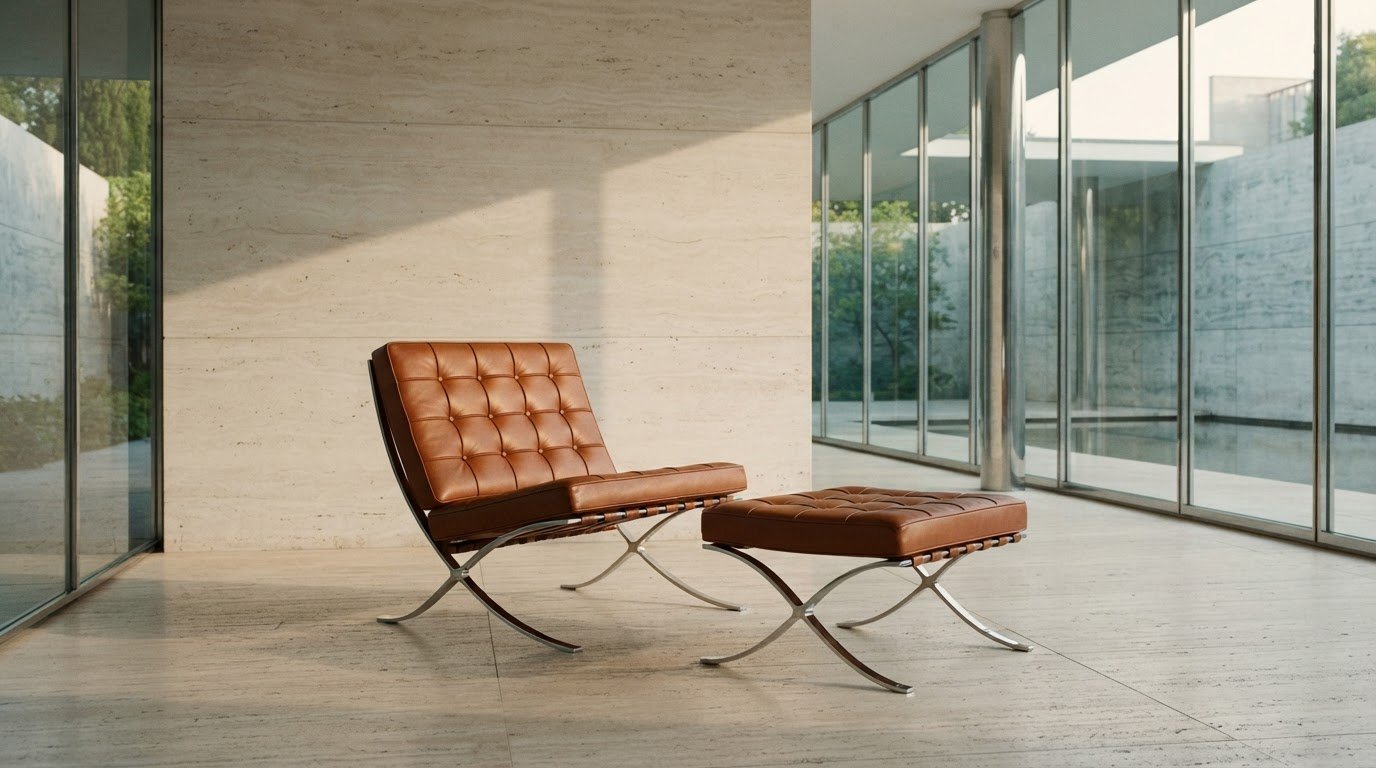
- The original Barcelona chair was designed in 1929 by Ludwig Mies van der Rohe with Lilly Reich, whose role in the design was long overlooked.
- It was created for the German Pavilion at the 1929 Barcelona International Exposition, where it was an integral part of the building.
- Because King Alfonso XIII was due to attend the opening, the chair was conceived as a monumental, ceremonial seat – though the idea that it was purely a “royal throne” is partly a myth.
- Its X-shaped frame is based on ancient Roman folding chairs, and it pairs chrome-plated steel with tufted leather.
- The licensed original has been made by Knoll since 1953. A quality reproduction offers the same design for far less.
The Barcelona chair is one of the most recognised objects in modern design, but the story of the original is often told wrong. The real history runs through a world’s fair, a demolished pavilion, a Spanish king who never sat down, and a designer written out of the record for decades. This guide covers who designed the original Barcelona chair, the 1929 exposition that gave it its name, and how it became a lasting icon.
Table of Contents
Who Designed the Barcelona Chair?
The Barcelona chair was designed by Ludwig Mies van der Rohe in collaboration with Lilly Reich in 1929. Mies was a German architect and one of the leading figures of modern design, later director of the Bauhaus. Reich was his creative and romantic partner, and a gifted designer in her own right. You can read the architect’s full story in our Mies van der Rohe biography, or explore all the makers we cover on our designers page.
For most of the twentieth century, the chair was credited to Mies alone. That is now recognised as unfair. Reich worked closely with Mies on both the German Pavilion and its furniture, and recent scholarship increasingly places her at the centre of the design – some historians argue she was its true driving force. Any honest account of the Barcelona chair designer has to name both. Mies gave the world the phrase “less is more”, but the Barcelona chair was the work of two hands, not one.
The 1929 Barcelona Exposition and the German Pavilion
The Barcelona chair takes its name from the 1929 Barcelona International Exposition, the world’s fair where it first appeared. Germany asked Mies van der Rohe to design its national pavilion for the event, and he and Lilly Reich created what became known as the Barcelona Pavilion – a low, open building of marble, glass, and steel that is now considered a landmark of modern architecture.
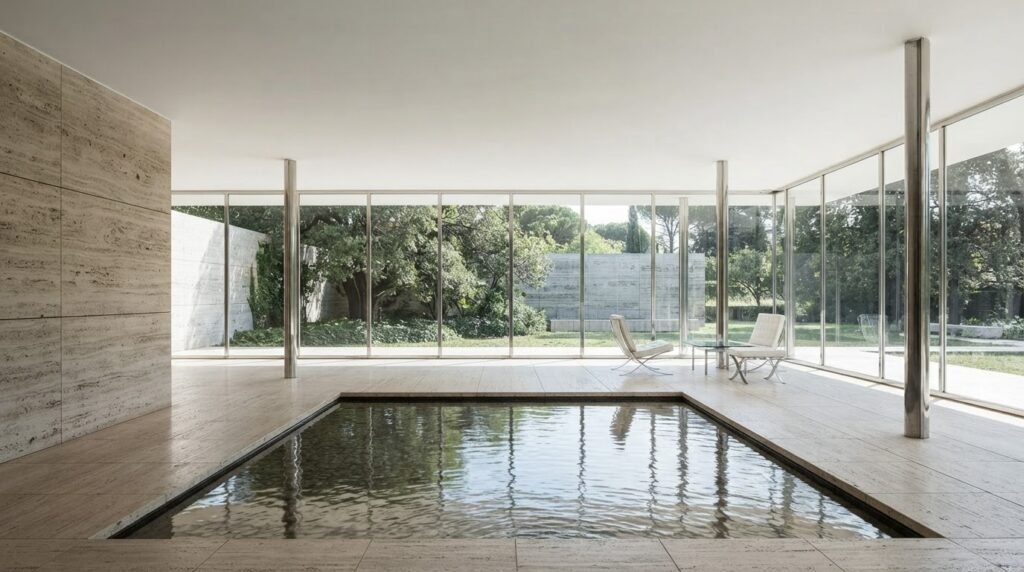
The pavilion was designed as a single, unified work of art, where the building and its contents belonged together. The chairs were not an afterthought placed inside a finished room. Mies positioned them as fixed elements of the design and intended them to stay exactly where he put them. The Barcelona chair, in other words, was born as part of a building before it became a piece of furniture in its own right.
A Throne for a King: The Royal Story and the Truth
The most repeated story about the Barcelona chair is that it was designed as a throne for Spanish royalty. The truth is more interesting than the legend.
King Alfonso XIII and Queen Victoria Eugenia were expected to attend the pavilion’s opening ceremony. Aware of this, Mies wanted seating worthy of the moment. He said the design had to be more than a chair – “a monumental object” – and, as he later put it, “you just couldn’t use a kitchen chair.” Only two chairs were made for the pavilion, and the ambition behind them was real.
Here is the part most articles leave out. Knoll, the chair’s official maker, notes that Mies’s “fit for a king” remark gave rise to the misconception that the Barcelona chair was designed purely as a royal object – an idea largely discredited by scholars. The chairs were first and foremost organisational elements of the pavilion. And by most accounts, King Alfonso XIII never actually sat in the modern throne created for him. The royal story is true in spirit, but the chair was always more architecture than monarchy.
Ancient Roots: The Curule Chair and the X-Frame
The Barcelona chair’s distinctive crossed legs are not a modern invention. The X-shaped frame is drawn from ancient folding chairs, particularly the Roman sella curulis, the curule chair used by Roman magistrates as a seat of authority, and the folding stools of ancient Egypt.
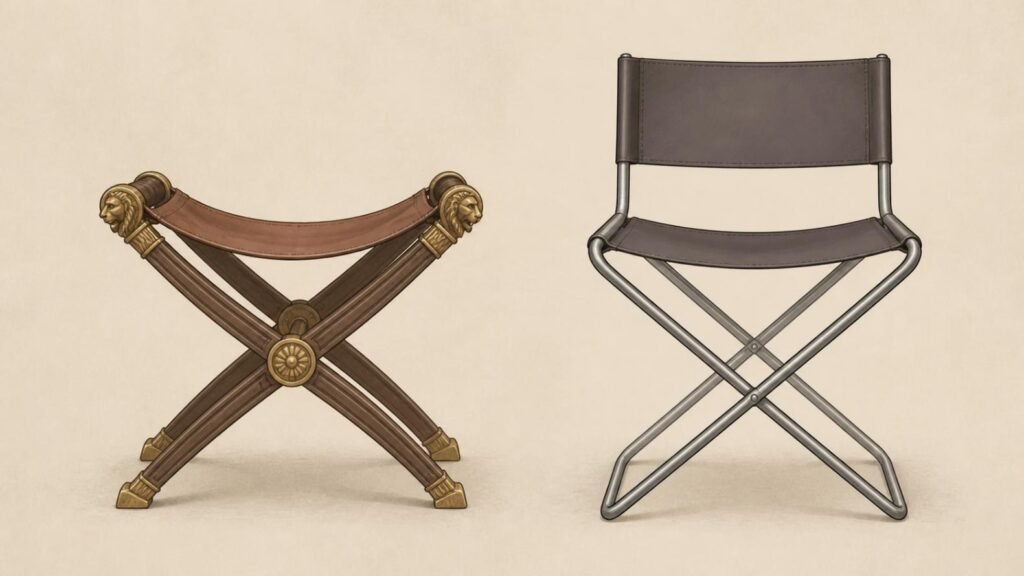
That lineage is the quiet genius of the design. By taking the shape of an ancient seat of power and stripping it down to two clean steel curves, Mies and Reich made something that reads as both timeless and modern. The chair carries the weight of a throne without a single decorative flourish. It is a modern object that quietly borrows the authority of the ancient world.
How the Original Barcelona Chair Was Built
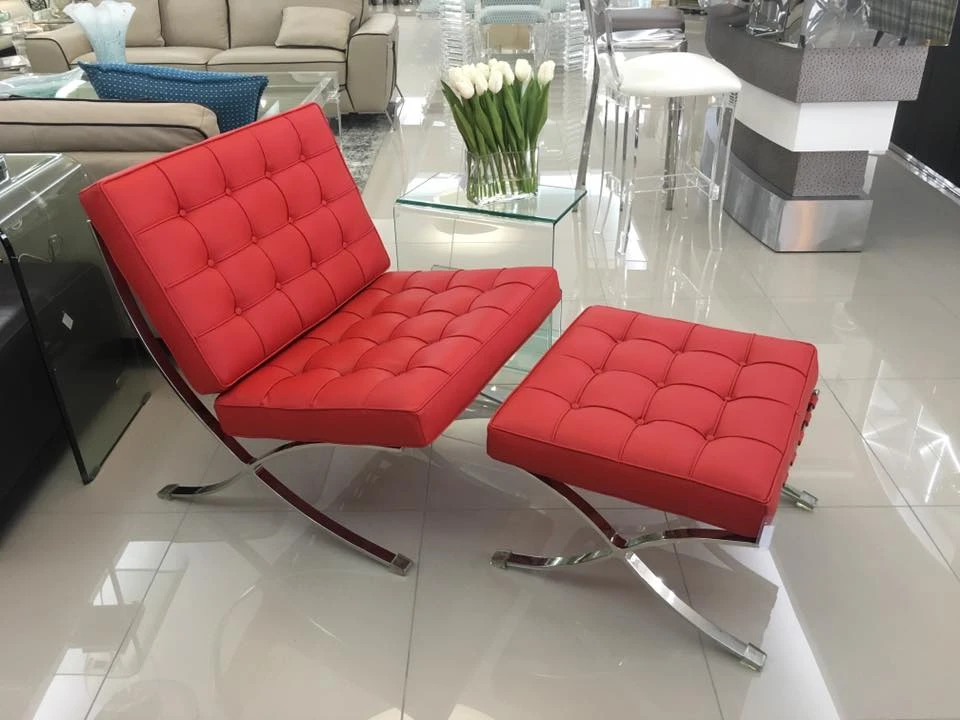
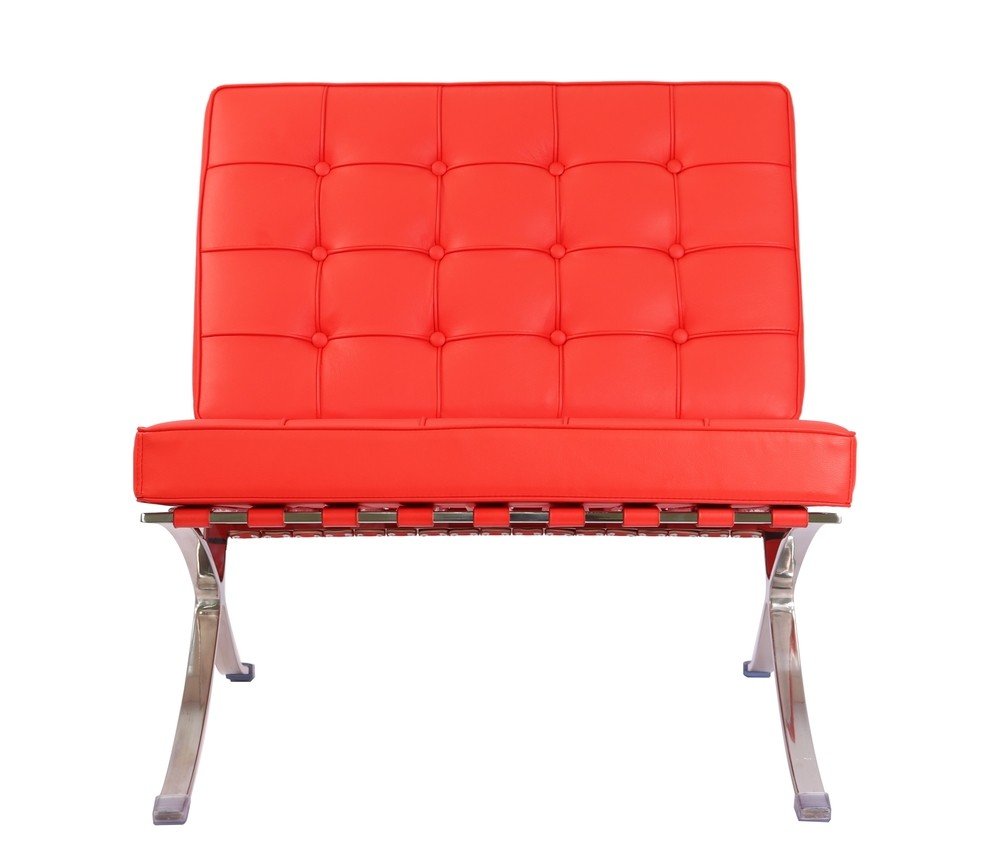
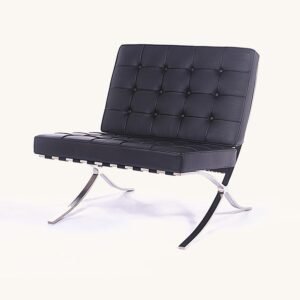
The original 1929 Barcelona chair looked different from the one sold today. It was built by hand from chrome-plated steel bars that were bolted together, upholstered in white pigskin, with cushions filled with horsehair. Leather straps supported the seat and back, and the cushions were divided into squares by hidden buttons, giving the tufted look the chair is known for.
The design was reworked in 1950 for larger-scale production. Here is how the original compares with a chair made today:
| Element | Original (1929) | Knoll production today |
|---|---|---|
| Frame | Chrome-plated steel, bolted together | Single-piece stainless steel, hand-buffed, no bolts |
| Upholstery | White pigskin | Cowhide leather in many colours |
| Cushions | Horsehair-filled | Foam, hand-tufted with hidden buttons |
| How many | Two, hand-built for the pavilion | Machine-made with significant hand finishing |
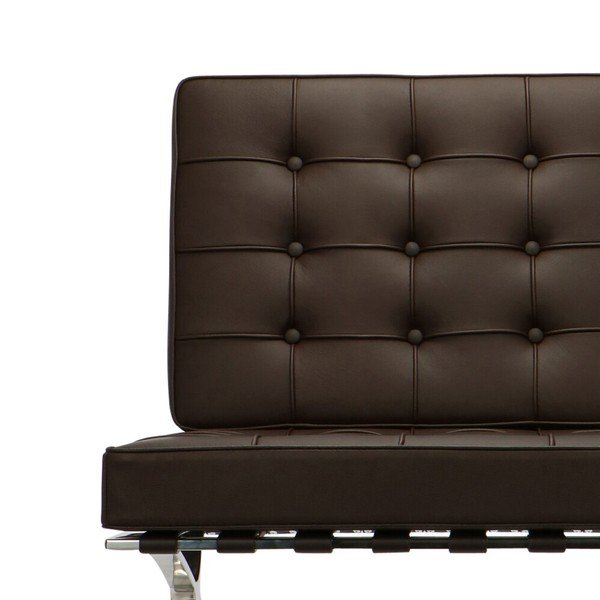
The move to a seamless single-piece stainless steel frame is the biggest change. It gave the chair the clean, unbroken lines people recognise today, without the visible bolts of the original.
From Pavilion to Icon: Production and Knoll
The Barcelona Pavilion stood for only about seven months before it was demolished in 1930. It was faithfully rebuilt on its original site in 1986 and can be visited today, but the chair outlived the building on its own.
Production began soon after the exposition, first through Berlin metal workshops. The chair reached America in 1930 in the New York apartment of the architect Philip Johnson, who had met Mies during the pavilion project. In 1953, Mies granted the American company Knoll exclusive rights to produce and sell the chair, and Knoll has made it ever since, in the United States and at its factory in Foligno, Italy. Knoll etches Mies van der Rohe’s signature into the frame of each chair as a mark of provenance.
Like the Eames Lounge Chair, the Barcelona chair moved from a single moment in design history into continuous production, and it has stayed in demand for nearly a century.
What Makes an “Original” Barcelona Chair Today
An “original” Barcelona chair today means one made by Knoll, the company that holds the licence and produces it to Mies van der Rohe’s specifications. A genuine Knoll chair carries the etched signature on the frame and comes with documentation, and it typically costs several thousand euros.
That price puts the licensed original out of reach for many people, which is where a quality reproduction comes in. A well-made Barcelona-style chair uses the same single-piece stainless steel frame, full-grain leather, and hand-tufted cushions, at a fraction of the licensed price. As with any design classic, the trap is the cheapest tier, where thin leather and hollow or weak frames show quickly. Our Barcelona chair collection focuses on the details that matter – frame, leather, and tufting – so you get the design and the presence without the five-figure outlay. You can also see our wider designer furniture range if you are furnishing a whole room.
Not sure what to look for in a reproduction? Our guide to what a Barcelona chair actually is walks through the key details – frame construction, leather grades, and tufting – so you can shop with confidence.
-
Barcelona Chair Replica, Barcelona Chair with Ottoman
Original price was: €979,00.€629,00Current price is: €629,00. Add to basket -
Barcelona Chair Replica, Barcelona Chair with Ottoman
Original price was: €979,00.€655,00Current price is: €655,00. Add to basket -
Barcelona Chair Replica, Barcelona Chair with Ottoman
Original price was: €979,00.€629,00Current price is: €629,00. Add to basket


How to Recognise a Quality Barcelona Chair
Because the Barcelona chair looks simple, it is easy to build badly, and the market is full of copies that miss the details. A good reproduction gets a few things right that a cheap one does not.
The frame is the clearest sign. A quality chair uses a single piece of stainless steel for each half of the X-frame, hand-buffed to a mirror finish, with the joint welded and polished so smoothly it almost disappears. Cheaper chairs bolt sections together, leaving visible screws and a weaker frame. The leather matters just as much: full-grain leather, cut into the correct forty panels and hand-tufted with the buttons pulled through by hand, ages far better than the thin, bonded leather used on budget versions. Finally, the chair should feel heavy and planted. The steel in a proper Barcelona chair gives it real weight, so a light, hollow-feeling frame is a warning sign.
The Rest of the Barcelona Collection
The chair was never meant to stand alone. For the German Pavilion, Mies van der Rohe and Lilly Reich designed a small family of pieces that share the same language of steel and leather.
Alongside the chair sits the matching Barcelona stool, which works as a footrest or extra seating, and the Barcelona couch, a leather-topped day bed. There is also the Barcelona table, a low square of glass on a chromed steel base. Together they make a coordinated set, and many buyers start with the chair and stool before adding the others. Each piece follows the same rule the chair does: clean lines, honest materials, and nothing added for decoration.
Where the Barcelona Chair Works Best
The Barcelona chair suits rooms where it has space and light to be seen. It was designed as a ceremonial object, and it still reads best as a focal point rather than everyday clutter.
In a home, a pair either side of a low table makes an elegant seating area, and a single chair angled in a corner turns dead space into a reading spot. Its formal, architectural look also suits offices, reception areas, and hotel lounges, which is where it is most often seen. Because the design is nearly a century old and has never fallen out of fashion, it settles comfortably into both modern and traditional interiors.
Frequently Asked Questions
How much does a Barcelona chair cost?
A licensed Knoll original typically costs several thousand euros, while a quality Barcelona-style reproduction costs far less. As with any design classic, very cheap versions cut corners on the steel frame and the leather, so it is worth checking both before buying.
What is the Barcelona chair made of?
The Barcelona chair is made from a stainless steel X-frame and leather cushions. A quality version uses a single seamless piece of steel for each side of the frame and full-grain leather, hand-tufted into the design’s forty panels.
Did Lilly Reich help design the Barcelona chair?
Yes. Lilly Reich worked with Mies van der Rohe on both the German Pavilion and its furniture in 1929. Her name was left off the credit for decades, and historians now place her at the centre of the design. You can read her full story on our Mies van der Rohe and Lilly Reich page.
Where does the Barcelona chair get its name?
From the 1929 Barcelona International Exposition. Only two chairs were built, and they were made as fixed elements of the German Pavilion rather than as furniture to be moved around.
Was the Barcelona chair really made for royalty?
It was conceived as a monumental, ceremonial seat because King Alfonso XIII was expected at the pavilion’s opening. However, scholars have largely discredited the idea that it was designed purely as a royal throne, and by most accounts the king never actually sat in it.
What is the Barcelona chair based on?
Its X-shaped frame is based on ancient folding chairs, especially the Roman sella curulis used by magistrates and the folding stools of ancient Egypt. The design turns an ancient seat of authority into a modern form.
Who makes the original Barcelona chair?
Knoll has produced the licensed original since 1953, when Mies van der Rohe granted the company exclusive rights. Genuine Knoll chairs carry Mies’s etched signature on the frame as proof of provenance.
How much does an original Barcelona chair cost?
A licensed Knoll original typically costs several thousand euros, depending on the leather and finish. A quality Barcelona-style reproduction offers the same design for a fraction of that price.
What is the difference between the 1929 original and the chair made today?
The main differences are the frame and upholstery. The 1929 original used chrome-plated steel bars bolted together and white pigskin. Today’s Knoll version uses a single seamless piece of stainless steel and cowhide leather. See our guide to when the Barcelona chair was designed for the full timeline.
The people behind the design have their own story. Read about Mies van der Rohe and Lilly Reich on our designers page.
Bring the Barcelona Design Home
The original Barcelona chair is a piece of design history, and the licensed Knoll version is priced to match. If you love the design but not the cost, a faithful Barcelona chair and ottoman gives you the same single-piece steel frame and tufted leather for far less. Explore our Barcelona chair collection to see the finishes available.
Follow Sederica in Google
Add us as a preferred source and our buying guides will appear more often in your Google results.
Add as preferred source
[…] as what it is. One deceives you; the other does not. For background on the design itself, see our Barcelona chair history and our biography of Mies van der Rohe, who designed it with Lilly […]
[…] The chair was not an afterthought placed inside a finished room. Mies designed the pavilion as a single, unified work, and the chairs were fixed elements of it. In other words, the Barcelona chair was born as part of a building in 1929 before it became a piece of furniture in its own right. You can read the full story of the pavilion in our Barcelona chair history guide. […]
[…] chair. The honest account names both designers. You can read the full story of the chair in our Barcelona chair history guide, learn more about the architect in our Mies van der Rohe biography, or see the other makers we […]
[…] gave her a solo exhibition, Lilly Reich: Designer and Architect, in 1996. For the background, read the full story of the 1929 pavilion or how Mies went from the Bauhaus to the Barcelona […]
[…] in 1986 (Ajuntament de Barcelona, 2016), and the Fundació Mies van der Rohe runs it today. Our history of the 1929 Barcelona Pavilion tells the full […]